Sparks to Signals
Building a biotechnological smart city
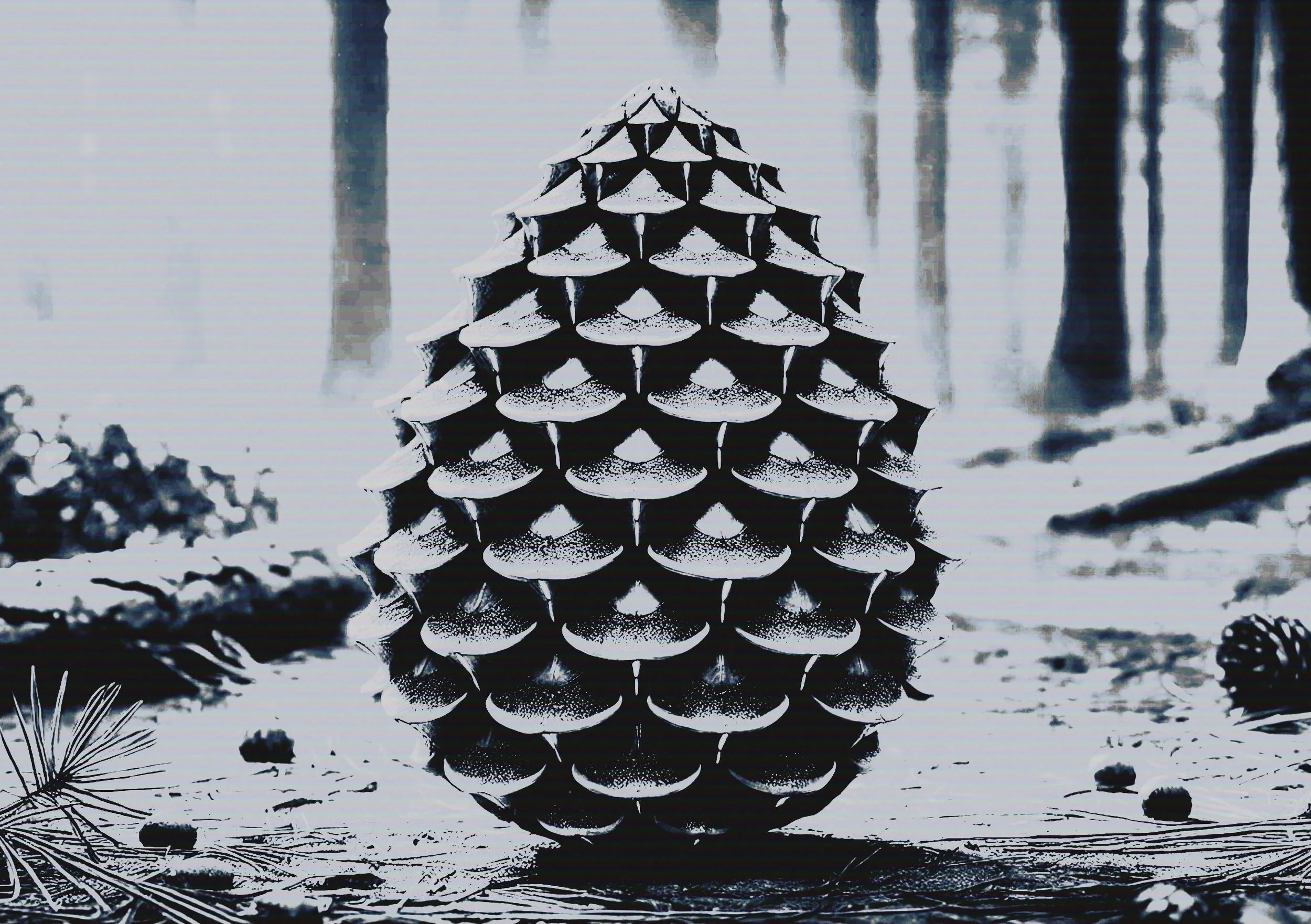
Image: One of several iterations of the seminal biomimetic wildfire sensing concept Pyri-CONE™, which inspired by serotinous cones that are native to California, was first described in Panarchistic Architecture (2018). The device, of which the name was coined from pyriscence - the scientific term that is used to describe seed release that has been triggered by wildfire - autonomously senses and processes environmental data using a combination of biochemical and ballistic processes that mimic those of the pinecones that inspired it. One of several unprecendented design concepts developed during the PhD research programme, this environmental sensor functions in an essentially passive way, in that it does not require an energy source, as it is activated by the melting of resins that hold its external parts together. This process then triggers the ballistic action that sends a signal to the biotechnological IOT network of which it is part. Like other components of the (B)IOT™, it enables real-time data to migrate across an ecologically smart environment network designed to enhance both wildfire resilience and recovery in the wildland-urban-interface.
Building a (B)IOT™ for Wildfire Resilience
As part of a series of articles designed to make my scientific research more accessible, select works have been translated by artificial intelligence that’s been trained using an array of my published works, including chapters from Panarchistic Architecture (2018). These translations have replaced specialist terminology and references with language which will be legible to non-specialists with an interest to learn more about the challenge of living with wildfire.
In my thesis and subsequent works, I argued that building wildfire resilience demands a radical departure from conventional architecture and urban planning that relies on centralised infrastructure and rigid defences. Conventional approaches treat fire as an external threat to be resisted, often failing under extreme conditions. I proposed an alternative framework that embraces nature’s adaptability, modelling cities on ecosystems that have coexisted with wildfire for millennia.
Instead of static structures, this approach envisions an “ecosystem of architectures” where buildings respond dynamically to environmental changes. Inspired by pyrophytes - plants that evolved to live with wildfire - that sense the advent of wildfire through features that enable them to identify the radiative heat of fire and the chemical signatures in smoke, I proposed a biotechnological internet of things - (B)IOT™, which integrates biological sensors and biocomputing more generally, and which harvests, processes, distributes, and stores data.
In theory, this IOT system could be wholly biotechnological, which was explored in some of the speculative aspects of the thesis, including scenarios and flash fictions. However, the immediacy of the threat to hand, that being a threat that became clear in analyses of the data on possible wildfire futures, I proposed that biosensors and biocomputing be integrated - spliced - with established technologies, including satellite imaging and processing, artificial intelligence, and supercomputing. But, whether wholly biotechnological, or a hybrid biotech meets e-tech system, unlike present-day approaches to wildfire resilience that rely on human intervention, this bio-inspired IOT system could autonomously activate structural defences, such as closing vents to block embers - automated ember guards - and deploying fire-resistant barriers, such as fire retardant shutters, across windows, doors, and other architectural and infrastructure features that make buildings more vulnerable to ignition.
This biomimetic model also rethinks data storage and monitoring. While conventional systems rely on vulnerable digital databases, DNA-based storage offers a long-lasting, disaster-resistant alternative. Bio-sensing technologies, from graphene-oxide sensors to plant-based networks, could provide real-time environmental intelligence, as in a form that evolves over time.
This vision also empowers communities. Instead of relying solely on emergency and other civic agencies, citizen-driven data collection strengthens wildfire response, fostering a shared responsibility, while also enhancing resilience through decentralised over centralised systems. By shifting from resistance to adaptation, this approach redefines how cities can survive — and thrive — in fire-prone landscapes.
Extract
Edge (bio)Computing for a New Fire Age
In a world increasingly defined by environmental unpredictability, humanity is turning to nature for new ideas. Among the most urgent challenges is learning to how to coexist with wildfire in fire-prone areas, particularly at the wildland-urban interface (WUI), where human developments meet untamed landscapes. Dr. Melissa Sterry’s research explores an innovative framework that combines architecture, ecological insights, and advanced electronic and biological technologies to create resilient urban environments. This approach is designed to serve as a beacon of hope in an age of climatic and wider environmental uncertainty.
Bespoke Biotechnological Resilience
Traditional approaches to planning and architecture often aim to provide universal solutions. Philosopher Jeremy Bentham envisioned a "single code" to address all societal needs. However, the complexities of natural systems, particularly fire-prone ecosystems, defy such simplicity. Sterry’s research proposes a three-part framework tailored to diverse environmental conditions and fire behaviours - an ‘ecosystem of architectures’ populated by a diversity of architectural and urban ‘genus’ and ‘species’.
This model leverages advancements in environmental monitoring and data analysis. Modern tools, from satellite imagery to artificial intelligence, provide unparalleled insights into wildfire dynamics. Organisations like NASA and the European Space Agency offer open-access satellite data to track active fires, assess vegetation health, and predict potential wildfire hotspots. When combined with cutting-edge tools like wireless sensor networks and citizen-generated data, this information helps develop a nuanced understanding of fire-prone regions.
Read the article ‘Building a (B)IOT™ - Biological Internet of Things’ in full here.