Sensors to Structures
The Role of Bio-Sensing in Wildfire Prevention
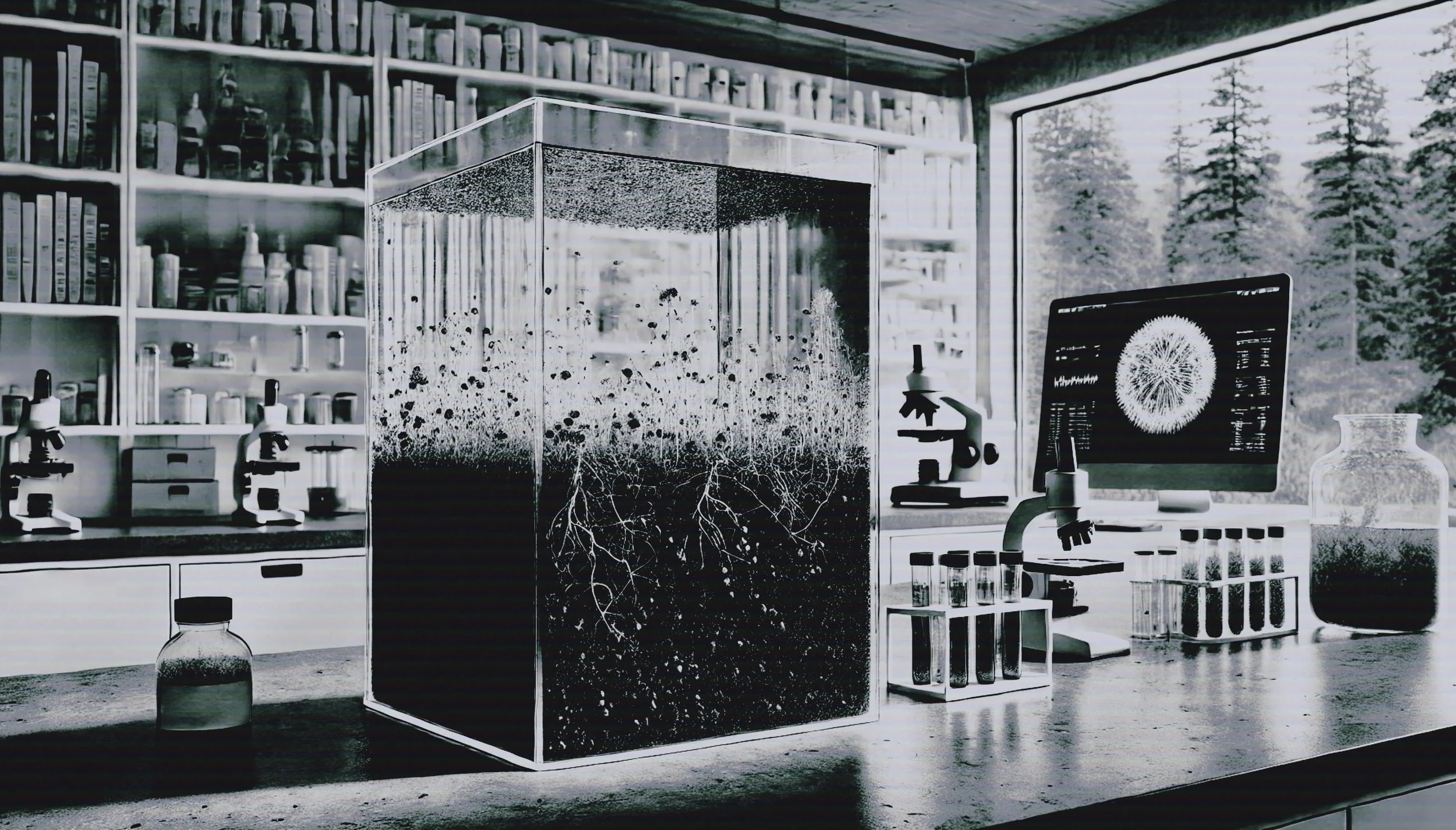
Image: Design for Wildfire school.
Codifying Flux: Trichotomous Design, Environmental Sensing, and Panarchistic Adaptation
Traditional approaches to environmental codification fail to accommodate the highly dynamic nature of fire-prone landscapes. Instead, Panarchistic Architecture (2018) introduces a tri-part method, one that embraces variation, real-time data integration, and systemic flexibility.
Expanding the scope of environmental monitoring, advancements in satellite imaging, AI-driven analysis, and decentralised sensing networks enable more precise wildfire prediction and response. From citizen-operated weather stations to high-resolution, open-access satellite imagery provided by organisations such as NASA and Planet Labs, these technologies augment the capacity for rapid, data-driven decision-making. Simultaneously, social media analytics and community-driven data aggregation reveal emergent methods for tracking and responding to fire events in real and near real time.
Beyond technological augmentation, part I of Chapter 7.1 explores the potential of biological intelligence as a model for architectural responsiveness. Drawing parallels between mycorrhizal networks and built environments, it envisions an infrastructural shift from centralised computation to decentralised permutation. Fire-adapted plant species — capable of sensing, responding, and regenerating in cyclical environmental shifts — inform a design ethos rooted in resilience rather than resistance. Experimentation in bio-sensing, shape-memory materials, and self-regulating building envelopes suggests a future where architecture does not merely withstand fire but dynamically interacts with it.
At the convergence of digital innovation and ecological intelligence, this chapter positions Panarchistic Architecture as a framework for designing with, rather than against, environmental flux. Could our built environments become as adaptive as the landscapes they inhabit? In reconciling technology with nature’s own codification systems, the path forward may lie not in rigid control, but in fluid, evolving symbiosis.
Extract
“Panoptical Permutations: From Computing to Permuting
Whereas humans compute, plants permute. Put simply, as you read this text your sensory organs are sending a stream of electronic signals via your nervous system to the epicentre thereof, which then utilizes some of its processing power to analyse said data. Although endowed with traits that enable them to ‘see’, ‘smell’, ‘feel’, and ‘hear’ their environment (Chamovitz, 2012), absent of a brain, plants, and their offspring, seeds, process sensory information in decentralised fashion [Fig. 80] (Fry, 2016; Kesseler and Stuppy, 2006). Thus, theirs is a very different kind of ‘intelligence’.
While ‘smart’ has become a ubiquitous term in the future cities debate, definitions thereof are highly ambiguous. However, ambiguity doesn’t wash in the WUI, and more specifically, whereupon a wildfire of such intensity as could incinerate a building and its abiotic and biotic contents in a matter of minutes is fast approaching. The bandwidth for cognitive dissonance zero, all such data to be utilised in the development of a Panarchistic architectural and urban design paradigm need be as neutral in its interpretation as that of the sensory organs of fire-adapted plant species. Impossible? Not necessarily.
Evolution a process not an event, the migration from centralised information processing, and the inherent interpretive bias therein, will be not momentary. But, as wide-ranging developments both within, and beyond architecture and urban design evidence, that journey is already underway…”
Read the ‘Macrocosms in Microcosms: Towards Trichotomous Perspectives’ in full here.