
Fire smart cities
Where e-tech meets biotech when building urban and peri-urban resilience to wildfires
An AI generated translation of Dr. Melissa Sterry’s Codification for Eternal States of Flow, Flux, and Fire’ Part I (2018) for the general reader.
Introduction
As wildfires become more frequent and intense due to factors including, but not limited to climate change and urbanisation of wildlands, the need for adaptive and intelligent urban design in fire-prone areas has never been greater. This article explores the potential of data-driven design and codification strategies that can help mitigate the risks posed by wildfires. From satellite monitoring to bio-inspired sensing systems, emerging technologies are shaping the future of resilient architecture and urban planning in the wildland-urban interface (WUI).
Rethinking Codification in Fire-Prone Environments
Traditional approaches to urban planning often rely on a one-size-fits-all model. However, in the context of wildfire-prone regions, a more nuanced and dynamic system is required. This article argues for a tri-part coding framework that reflects the varying environmental conditions and fire behaviours within the WUI. Unlike rigid legal frameworks, which struggle to accommodate complex and evolving risks, an adaptive system integrates real-time environmental data to inform building regulations and urban layouts.
The Role of Satellite and Remote Sensing Technology
Advancements in satellite imaging and remote sensing have revolutionised wildfire monitoring. Organisations such as NASA, ESA, and USGS provide open-access satellite imagery that enables researchers to track fire activity in real time. These capabilities include:
Detecting active wildfires using thermal imaging satellites like MODIS and AVHRR.
Mapping burn scars and fire perimeters with high-resolution imagery from the Landsat fleet.
Assessing fuel availability and flammability with sensors such as RapidEye and AVIRIS.
Start-ups like Descartes Labs provide access to vast datasets, enhancing predictive modelling and improving early warning systems. Artificial intelligence further strengthens these efforts by rapidly processing large-scale imagery to identify fire-prone areas and project potential fire spread patterns.
Citizen Science and Real-Time Data Collection
Technology is not solely in the hands of large institutions; local communities also play a crucial role in wildfire monitoring. Citizen-operated weather stations provide real-time meteorological data, complementing government-led efforts. Social media platforms also serve as valuable tools for tracking fire activity, as seen with apps like Haze Gazer, which analyses Twitter activity to map smoke spread and identify health risks.
Despite concerns over privacy and security, integrating citizen-gathered data into official response strategies enhances real-time decision-making and fosters community resilience.
Learning from Nature: Bio-Inspired Adaptations
Nature has developed sophisticated mechanisms for adapting to fire, offering valuable insights for architectural and urban design. Unlike centralised human-designed systems, natural intelligence—such as fungal networks that communicate environmental changes—operates in a decentralised manner. Applying this principle to urban planning, we can develop architectures that respond dynamically to environmental conditions rather than relying solely on static design features.
Some pioneering projects in bio-inspired environmental sensing include:
PLants Employed As SEnsor Devices (PLEASED): A European research initiative exploring how plants react to stimuli like heat and flames.
Flexible graphene-oxide sensors: Wearable technology for plants that monitors biomass hydration, providing critical data on fire risk.
By embedding natural sensing capabilities within urban environments, buildings could autonomously respond to fire threats in real time.
Smart Architecture: From Computing to Permuting
The concept of ‘smart cities’ is often associated with digital automation and AI-driven solutions. However, in the context of wildfire resilience, ecological systems thinking intelligence lies in designing buildings that do not merely compute data but permute — adapting structurally in response to environmental changes.
Examples of adaptive architectural innovations include:
Hydramax (Future Cities Lab): A building envelope system that uses shape-memory alloys to respond to weather fluctuations.
Bloom (DOSU Studio): A bimetallic structure that expands or contracts based on temperature changes.
HygroSkin (Menges, Krieg, and Reichert): A timber pavilion with humidity-sensitive apertures inspired by pine cones.
These projects exemplify how architecture can transition from rigid, centralised intelligence to a distributed, responsive system, much like the adaptive mechanisms found in nature.
Towards a Living Internet of Things (LIOT)
The fusion of biological and digital intelligence could create a Living Internet of Things (LIOT), where natural organisms and smart sensors collaborate in monitoring and responding to wildfire threats. Technologies already advancing this vision include:
Soil hydration sensors that indicate vegetation dryness, providing early warnings for fire risks.
Animal movement tracking via GPS to detect behavioural shifts that signal approaching fires, drawing on indigenous knowledge that has long used wildlife patterns for hazard prediction.
Conclusion: A New Era for Wildfire-Resilient Design
The increasing prevalence of wildfires demands a radical rethinking of how we design and regulate our built environments. By leveraging real-time data, bio-inspired intelligence, and adaptive architecture, we can create urban landscapes that are not only fire-resistant but also inherently resilient. The future of wildfire safety lies not in rigid codification but in dynamic, responsive design—one that evolves with the environment and harnesses nature’s own strategies for survival.
As technology and ecology converge, we stand at the cusp of a new paradigm in architectural and urban planning—one that embraces complexity, decentralisation, and continuous adaptation in the face of an ever-changing climate.
Find some earlier examples of Dr. Sterry’s explorations of ecologically smart cities here and read the the chapter from which this article was generated here.
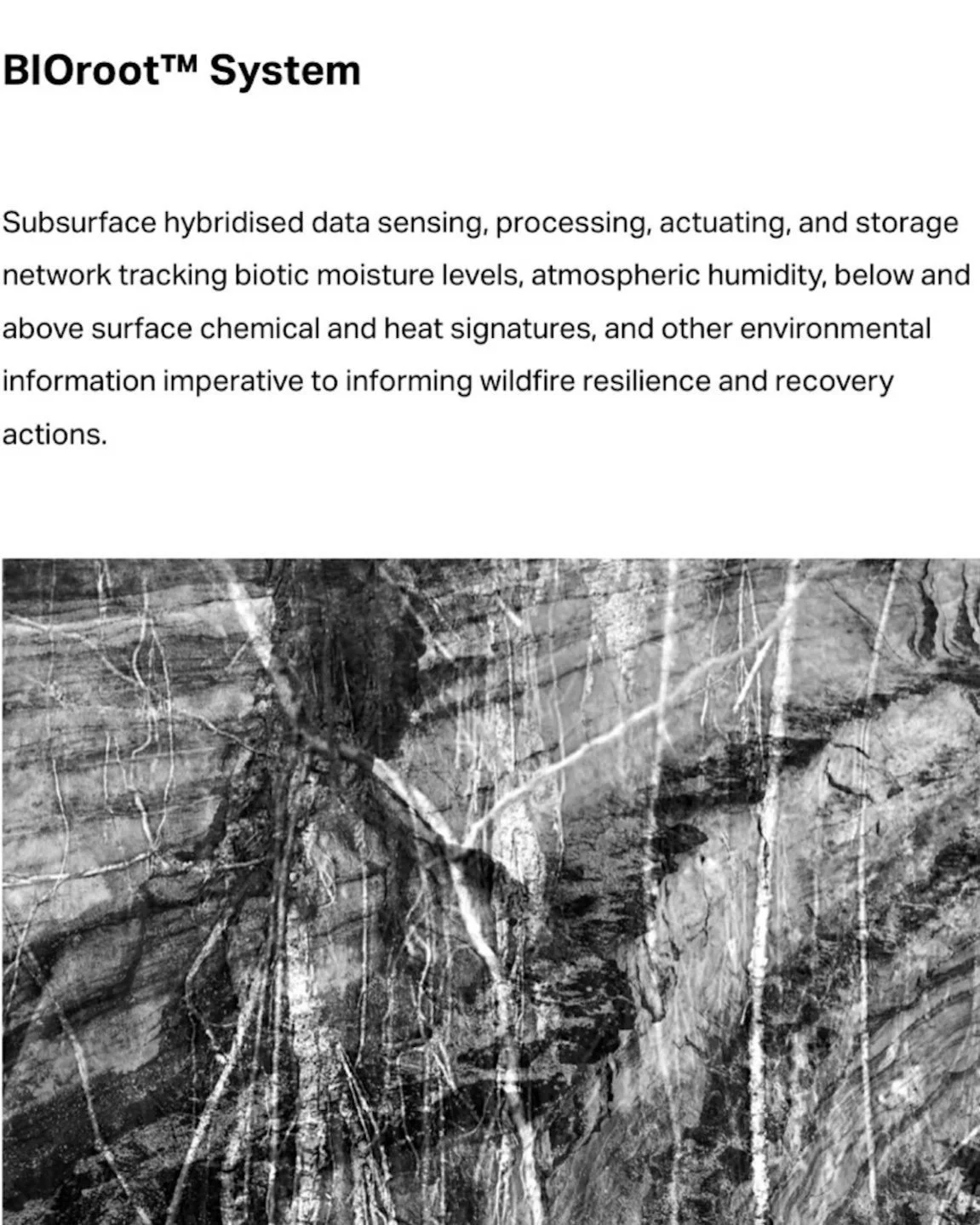
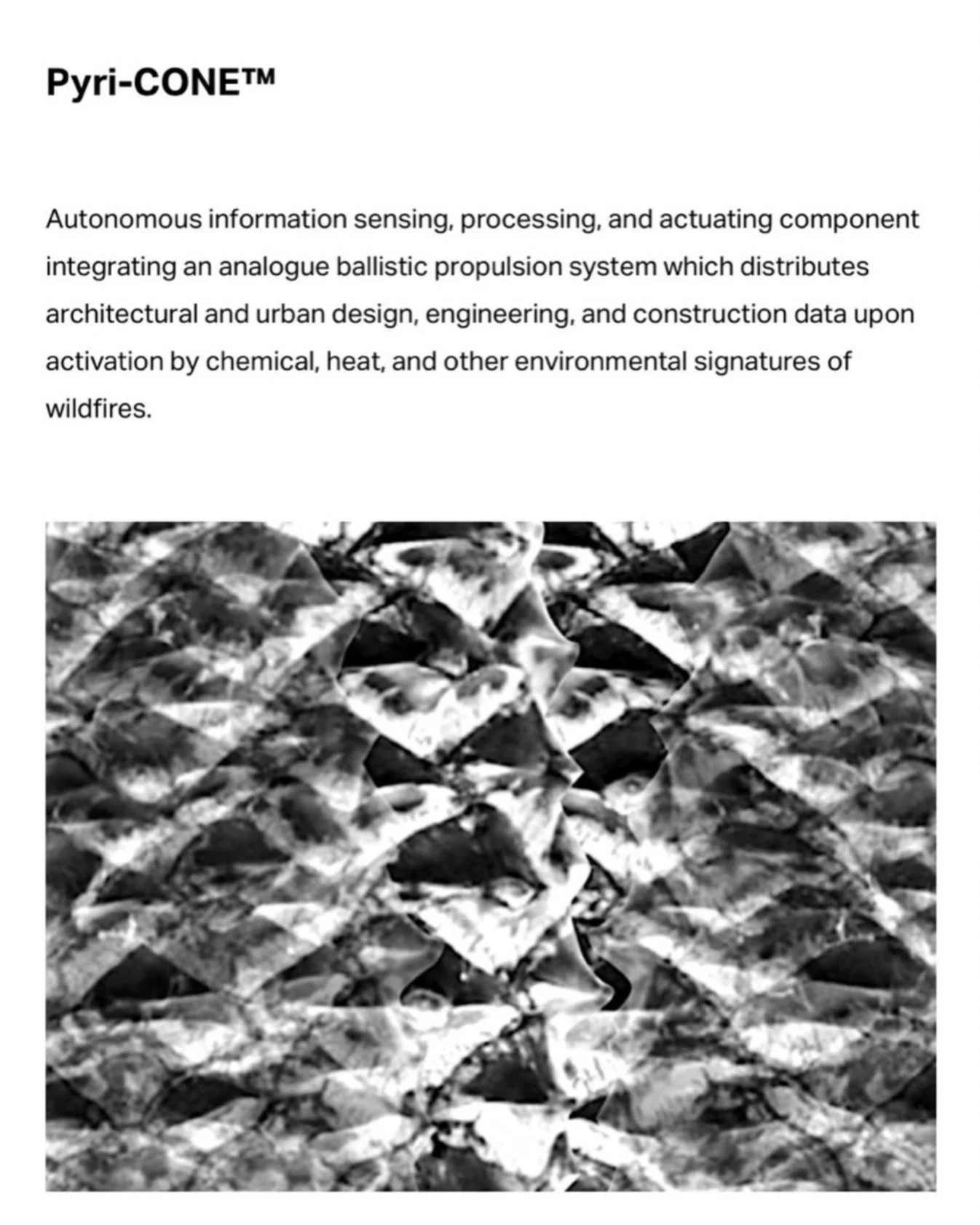
Images: [Top/Bottom/Storyboard] sketches of early iterations of Dr. Sterry’s biomimetic fire retardant smart exterior cladding system Retardant BIObark™; [Storyboard] sketches of early iterations of Dr. Sterry’s seminal bio-inspired wildfire sensing design concepts BIOroot System™ - a subterranean data sensing, processing, and storage network which mimics the root systems of pyrophytic trees, and Pyri-CONE™ - an autonomous wildfire sensing, processing, and actuating component, which modelled on serotinous pinecones, identifies the heat and chemical signatures of wildfires and disseminates environmental data to the (B)IOT™ - a biotechnological internet of things - through a ballistic action triggered by the melting of resins that hold its exterior parts together. Three of several design concepts that were published in Panarchistic Architecture (2018), and in several more recent publications, these unprecedented biotechnologies are designed to enable the creation of a smart wildland urban interface which enables resilience to wildfires through a real-time hybridised information communications technology network connected to biomimetic architecture, infrastructure, and utilities, inc. the electric grid and water supplies. Learn more about the concepts and the codes that govern them in the codex here and the conclusions of her PhD thesis here.



Images © Melissa Sterry All Rights Reserved
