Bio-Intelligent Urbanism
Biocomputing for Wildfire Resilience
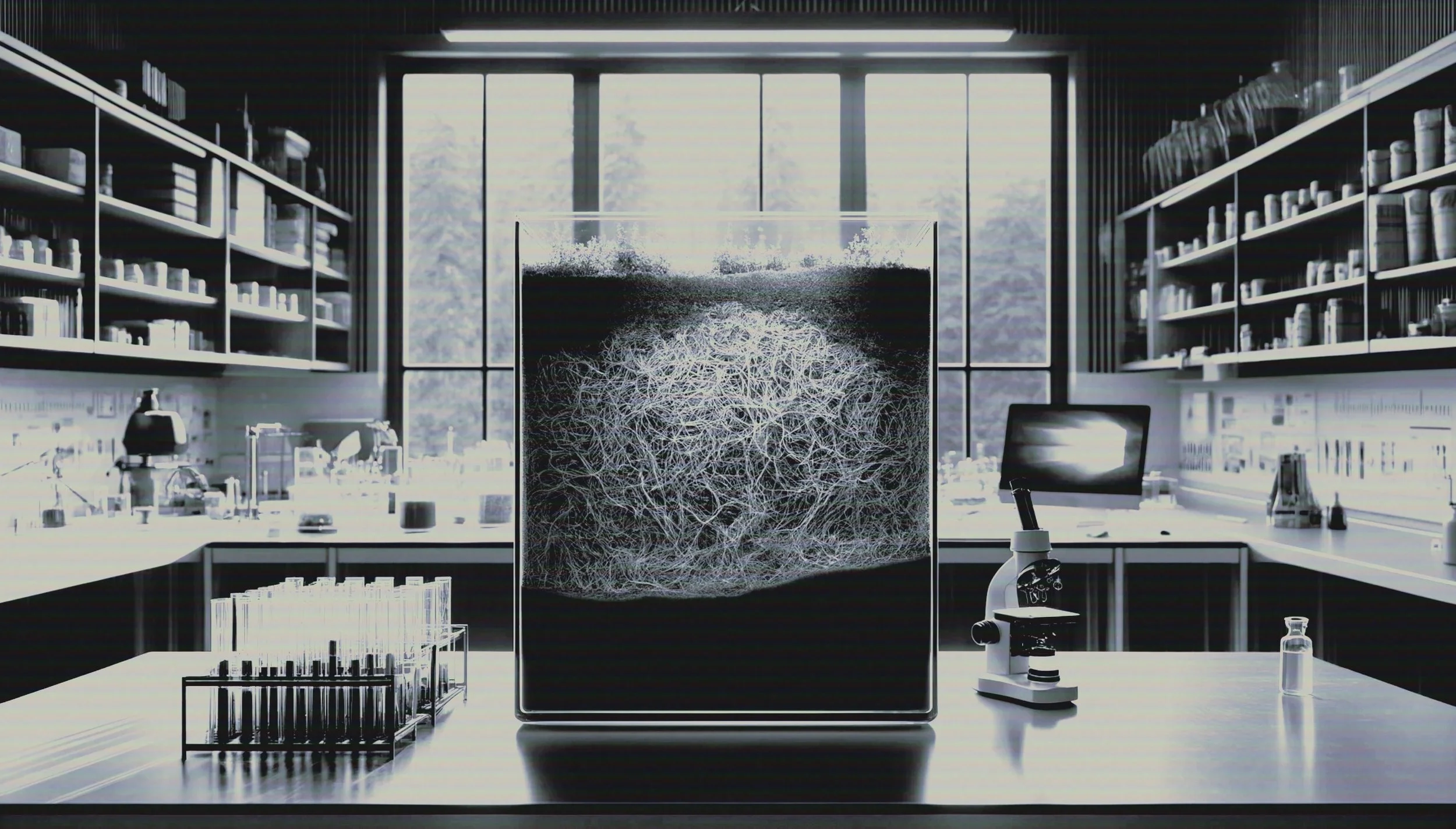
Image: Design for WIldfire school.
DNA Storage and Biocomputing for Fire-Resilient Innovation
In nature, resilience is not about permanence but adaptation. Unlike mobile fauna, plants and ecosystems evolve over millennia to withstand environmental flux, embedding survival strategies into their very materiality. Part II of Chapter 7.1 in Panarchistic Architecture (2018) explores the architectural implications of such endurance, questioning whether the built environment can mirror these regenerative cycles rather than resist them.
From biofabrication to in-situ recycling, emerging methodologies are redefining material permanence, shifting towards a paradigm where structures are designed to decompose, renew, and evolve. Fire-adaptive species like Pinus contorta and Quercus chrysolepis offer blueprints for this transition, demonstrating how strategic material investment safeguards not only structural integrity but also the continuity of encoded information. Traditional Native American architectures, which embrace seasonal rebuilding, further reinforce the value of ephemerality in design.
The chapter interrogates the future of construction through the lens of cyclic regeneration. Bio-engineered and biomaterials that dissolve into nutrients, fire-responsive architectural elements, and self-regenerating structures herald a shift towards buildings that actively participate in ecological renewal. The chapter proposes that architecture, like fire-adapted flora, rises anew from its own ashes — each iteration refined, evolved, and responsive to its environment, and argues that the foundational technologies to enable this seemingly impossible vision are already in research and development.
By integrating biofabrication, environmental sensing, and material intelligence, architecture may no longer be a static imposition on the land but a dynamic, evolving presence within it. In an era of climate volatility, will the cities of tomorrow abandon rigid permanence in favour of an architecture that lives, dies, and regenerates? The answer lies at the intersection of material science, bio-inspired design, and ecological symbiosis.
Extract
“Smoke Signals: Pyrophilic Sensing, Signalling and Symbiogenesis
Reverting to the Panarchistic design, thinking, and policy brief, ways in which the above referenced sensing, actuating, analysis, data storage, networking, and material developments may enable architecture as cyclic biochemical process of material & information exchange, which, built to burn, recurrently rises from its ashes, but, upon doing so, evolves with each phoenix-like incarnation, include:
Resprouting
Transitioning towards biological data storage of architectural ‘DNA’, interim technologies, such as those cited above, could store all such data as is required to ‘clone’ architectural and urban assemblages [i.e. specifications and blueprints]. Whereas replication of hazard-vulnerable architectures has grave social and environmental consequences, whereupon, like endurer species [i.e. Populus tremuloides], material, structural, morphological and other traits enable persistence in fire-prone regions, the inverse applies.
Pyriscence
Environmental sensing, actuating, analysis, and networking technologies, biological and otherwise, now facilitating real-time local, regional, and global monitoring of both cyclic and sporadic planetary processes, and the body of architectural experiments in environmentally-adaptive material morphologies fast growing, the foundations for wildfire as regenerative urban catalyst are laid. Ways in which the field may advance include interrogation of the potentialities for heat-triggered structural transitions, such as those that occur when the resins in the cones of fire- adapted Pinus species [i.e. Pinus contorta] melt. Ways in which mimicry of said process may activate architectural ‘reproduction’ include the release of fabrication agents [i.e. self-organising biological materials]; of both locally and remotely stored data as may be used for purposes including construction, production of furniture and other household goods, and insurance claims; of emergency supplies [i.e. food, water, and medicine]; and of notifications to family, friends, peers, and colleagues of the loss of property, thus need of assistance [i.e. accommodation, emotional support, etc.] Upon reproduction of homes and their contents, as/where applicable, this process allows for evolution [i.e. specification upgrades].
Pyrogermination
As with pyriscence, the process of pyrogermination could be enabled through transference of existing and emerging sensing, actuating, analysis, and networking technologies, biological and otherwise. However, whereas, pyriscence is a heat- activated hybrid biochemical-mechanical process [i.e. changes in the former trigger response in the latter], pyrogermination relies wholly on receipt of chemical signatures, thus data, and in some instances, technologies as facilitate the acquisition and analysis thereof, would be different to that of pyriscence. As in fire-adapted species [i.e. Pinus attenuata], pyriscence and pyrogermination would be symbiotic, wherein their means of enabling architectural and urban reproduction would be not mutually exclusive.
Abscission
Architectural abscission, wherein external features that could carry fire from floor to roof [i.e. biotic assemblages, such as flora-clad trellises], which shed prior to the arrival of wildfire, could be facilitated through myriad mechanical processes. For example, as with pyriscence, material state-change, such as they exhibited by Menges et al’s HydroSkin, could release building components. Alternatively, sensor-activated automation could achieve the same ends. But, whatsoever methods were applied, architecturally the approach would be akin to buildings that shed their flammable skins, the timing and the extent thereof relative to the fire-regime and its behaviours. As in fire-adapted species [i.e. Pinus ponderosa], abscission timing and extent would be correlated to fire frequencies and intensities, thus genera specific.
Retardance
Chemically, structurally, and morphologically, both biofabricated and biomimetic materials may be designed and/or cultivated to retard fire. In some instances [i.e. mycelium and cork] biological materials have innate fire-retardance. Either way, as evidenced in several of the experiments cited earlier, like their wild counterparts, these materials exhibit the properties of self-organisation, including cyclical and/or event-activated renewal and repair. As relates to biomimetic materials, interest in fire- retardance growing, it is, most likely, but a matter of time before material scientists innovate roof tiles and other exterior building products which mimic the fire-retardant morphology of resistor species [i.e. Pinus coulteri].”
Read Chapter 7 part II, ‘Pangenical Materiality: Living in a Cyclically Material World’ here.