An interview with serial founder and technology expert Dr. Robin Daniels
September 30th 2023. Melissa Sterry
Focused on environmentally sensitive applications of technologies and business models to drive innovation and investment into the fight against climate change, social inequality and habitat loss, Robin Daniels, PhD is founder and managing director of Ventures & Impact Studio, Redpill Group. He has previously founded or co-founded multiple businesses, and held senior teaching and research positions at institutions including Cambridge University and University College London. Here Robin shares thoughts on how leading-edge advancements in fields including sensing, artificial intelligence, and quantum computing are opening new horizons in environmental monitoring, modelling, and more…
MS: As someone that’s worked with artificial intelligence and other technological systems for now many years, which do you consider to be the most seminal recent advances with respect to monitoring and modelling Earth Systems and why?
RD: The modeling and monitoring of Earth Systems is, without doubt, one of the most important tools in tackling climate change. The need to radically reduce, and reverse, deforestation and the calamitous loss of biodiversity underpins the case for data to understand the situation now and to predict possible future trends and events. The challenge, as with many systems approaches to tackling complex problems, is the volume of data that is very easily generated, in addition the quality and interoperability of that data. Add to this, issues of data ownership and privacy, of intellectual property and the right of individuals who participate in the generation of that data and it’s clear that some serious innovation is required. An open-source global platform for climate and biodiversity data would address these challenges head-on. Colleagues at the Cambridge Centre for Carbon Credits and the Cambridge Conservation Initiative are developing the case for planetary computing: accessible, interoperable and extensible end-to-end systems infrastructure to process petabytes of global remote-sensing data for the scientific analysis of environmental action. This advance will revolutionise the ways in which science and technology can underpin the development of new commercial and economic models in tackling the climate emergency.
MS: Advances in ariel and satellite imagery mean that we’re now able to monitor vast tracts of forest and other biomes in extraordinary detail and in some cases in real and near-to-real time. Thinking to the current research projects in this field, which do you consider to be the most interesting and why?
RD: The work of Amatech Ventures in Brazil stands out as a particularly interesting example of how technology is being deployed in monitoring forests, in this case the Brazilian Amazon. It's true that technology allows us to monitor changes from space, although we can only see as far as the tree canopy. To really understand what's happening on the ground it will always be necessary to include an element of ground truthing in monitoring changes to natural environments. This can be supported by the application of terrestrial sensors including camera traps, eco-acoustics, environmental DNA monitoring and other tools, but always with the direct involvement of local experts, communities, and indigenous peoples. Their tacit knowledge is an invaluable component in the development of truly robust solutions for the long term. Working with local communities and its 50,000-acre private reserve in the state of Amazonas, Amatech Ventures is engaging business and universities in the development and deployment of a suite of technologies that use data to better understand and predict the health of the rainforest and the animals and plants living within it. One particularly interesting element of this project is the focus on developing a pragmatic approach to the generation and analysis of data. Data generation and analytics has a significant carbon footprint, so the question needs to be asked “what's the minimum amount of data that we need in order to deliver the impact that we're striving for?” At the same time, real time data is very rarely practicable in an environment like a rainforest. For this reason, the development of an outcome and impact-focused technical architecture and data strategy that combines earth observation with terrestrial data is crucial if we are not to be swamped with data that in the end obfuscates its true meaning: quite literally not seeing the wood for the trees.
MS: Sensing technologies have likewise seen some significant advances of late. Which of these do you think has been the most significant in both the short and long-term and why?
RD: One of the most significant developments in sensing technologies has been the recent push into the automation of environmental DNA analysis. eDNA is a great tool when it comes to really understanding the health of biodiversity in an area. Through the collection and analysis of samples on the ground it's possible to identify perhaps 40 or 50 different species per analysis. However, the approach has always been particularly manual: requiring people on the ground collecting samples, taking them away to a laboratory, carrying out the analysis and then producing a report. Recent advances in the use of drones and other devices for automatic or semi-automated sample collection and analysis provides the opportunity to use DNA data in conjunction with that collected via camera traps and eco-acoustics, for example, to develop a truly granular, accurate and timely audit of the biodiversity in a natural environment. It's really the opportunity to develop a combination, a toolkit, of high-quality sensing technologies that promises the greatest breakthrough.
MS: In a world of hype around many technologies, what do you think are the most significant risks of both AI and machine learning in general as relates directly to the environment and our place in it?
RD: The biggest risk from development of AI machine learning and the huge processing and analytics capacity and capability is that we end up drowning in data. My experience over many years and across a number of sectors is that there is a very natural and understandable propensity of the tech sector to push solutions to ill-defined problems. I saw it through working with many public sector and private sector corporations working on Smart City projects, for example, and I see the same trends happening now. However, the bigger risk that we all face is that AI, machine learning and huge volumes of data that don't really add any value or deliver any additional understanding actually slow the progress of innovation that’s crucial to addressing some of the existential challenges that we face.

MS: What possible advances do you think we’re likely to see with respect to applications of artificial intelligence to environmental monitoring and modelling in the coming several years, and what impacts do you think those advances could have?
RD: I think there are two main areas of development that are particularly interesting and that are developing quite quickly and will no doubt continue to do so in the coming years. The first relates to prognostics and being able to ingest large volumes of data from multiple sources and from those that predict the behaviour of natural ecosystems, whether that be climatic systems, biodiversity, levels of carbon sequestration, etcetera, and particularly understanding how those different systems interact with one another. That capability will allow us to hopefully get ahead of some of these problems and spot poor decision making before it has a chance to have a real impact. The second area relates to economics and financial models. AI applied to the monitoring, measurement and analysis of natural capital presents an opportunity to really accelerate the way in which nature is not only made financially visible, but made material to mainstream investors. The ability to demonstrate impact and to measure value across a range of different dimensions, to check for additionality, to factor-in social and socio-economic impacts, as well as carbon and biodiversity measures, and converting all of that into assets and liabilities on the balance sheet will help us to change the way that money flows, creating a virtuous circle where your dollar has a positive and lasting impact.
MS: The discovery of the Wood Wide Web is just one of now many examples that illustrate how sophisticated the living information networks of the world are. How do you foresee e-technologies integrating with biotechnologies to help us better understand the world about us in the near and medium-term future?
RD: In sustainability, environmental science and climate tech there's a very natural and understandable focus on large climate systems, the water cycle, rainforests, glaciers and so on. What’s all too often overlooked is the small and very small. The discovery of things like the Wood Wide Web points to a whole world of, as yet undiscovered, ecosystems. So the idea of creating a sensed environment in soils, for example, to be able to measure and monitor the carbon sequestration capacity of soils and how that alters depending on external factors and the way that the soil is managed, hold the opportunity not only to unlock huge additional sources of carbon sequestration capacity but allow us to manage the soil, its microbiome and the very small, but incredibly significant parts of the food chain that are all too often overlooked. Projects that are starting to push in this direction include the work of the UNESCO North Devon Biosphere, where I am a Trustee. Our smart biosphere project is essentially the development of a smart catchment system, monitoring in real time several different water parameters and using those to both understand a much wider range of characteristics and to predict future effects on water quality from run-off and other external factors.
MS: There’s a lot of speculation around how possible breakthroughs in quantum computing could impact the sciences and technology. What are your thoughts on the potential of this field, and particularly on how possible future advances might change how we compute information from the Earth systems, including data on the health state of forests and other biomes?
RD: Of course, quantum computing is a well-understood and recognized area of potential around many of these challenges and we’ve see it deployed for many years in weather forecasting by meteorological service providers like the Met Office in the UK. The significance of the ability to ingest and process large amounts of data from complex systems is well understood. The challenge is to think about the front-end of the user experience and make that computing power and the insights that you can bring accessible to as many people as possible, in the easiest way possible. The idea of a global open source repository and analytics platform for planetary data is one example of how that starts to manifest. Following that logic, possibly the biggest opportunity for quantum computing will be to make the data, the information, and the knowledge that can be generated made available to people on the ground - to local communities and to indigenous peoples. The opportunity to complement quantum computing and artificial intelligence with advanced sensor technologies to coordinate the design and development of appropriate technologies that are relevant and applicable to some of the most basic human and social needs is probably the single biggest opportunity.
MS: Futures and foresight discussions tend to revolve around high-tech solutions. However, the world is abundant in low-tech concepts, many of them not just proofed, but proofed for millennia. Thinking to ancient, indigenous, and vernacular solutions to environmental problems, which inspire you most and why?
RD: That's a great question and really difficult to answer. There are so many technologies or approaches or solutions which might appear novel but are in fact rooted in generations of development. Rather than identifying one particular solution I think I'd like to point to an ancient approach to innovation: that of viewing the world in ways that generate pragmatic and workable solutions, i.e. watching. For how many years did people use suitcases before someone sitting on a station platform watching people struggling, lifting suitcases onto trolleys, have the idea of putting the wheels straight into the suitcase? For how long did we have suitcases and for how long did we have wheels before that connection was made? It was only made through watching and observing. Indigenous peoples, people who are rooted in their landscape, in their environment, see things that those less familiar with it just don't. There’s a great story I was told just recently about an expedition into an area of the Congo rainforest. Researchers from a European university were sitting speaking with the community in the center of a village when one of the local women said “it's going to rain, we need to move inside, there’s going to be a storm”. The researchers looked around, not a cloud in the sky. But they went inside and sure enough 5 or 10 minutes later the heavens opened and it was an absolute deluge. They asked the woman how she had known that the weather was going to change. She replied, “I didn't know, the insects did”. She knew it was going to rain because of the behaviour of the insects who had sensed it 5 or 10 minutes before it happened. She had seen an ancient signal that was invisible to the PhDs from the northern hemisphere.
MS: You’ve led many projects and companies that have taken ambitious technological and wider STEM ideas from paper to reality, working with many leading research institutions along the way. What do you think are the foremost critical factors in enabling groundbreaking innovation and invention to progress from the abstract to the tangible, and in times as economically and politically unstable as these?
RD: In my experience if you're bringing an innovative and disruptive technology to market the most important thing you need to think about is who is going to be dis-intermediated as a result of this. If you have a solution that's going to solve a particular problem which is currently being approached in a different way, then people are going to resist the adoption of the new approach. This is particularly challenging when the people who are currently doing the job are also the budget holders or responsible for acquiring new technologies. Turkeys don’t vote for Christmas.
Once you’ve figured out where your main blocker is going to be and developed a strategy to deal with that the second challenge is to figure out what's the critical or even optimum set of conditions that will allow you to push this forward. And the underlying question there is “how do I get the market to come to me?”
MS: Knowledge transfer can enable rapid advancements between STEM fields. However, the fact that the culture and language of disciplines varies means that sometimes insights can get lost in translation. Having built and managed teams of experts working across fields, what’s your advice to those looking to do the same?
RD: Again, that's a great question. Of course, it's true that the secret to bringing any great innovation to market is having a very interdisciplinary or transdisciplinary approach to its development and deployment. The ability to translate between and across disciplines is a very important skill set as part of that, but it only gets you so far. The best way to manage and lead teams of people operating in different cultures and different languages is to focus on the end game, focus on the objectives and get everyone sitting on one side of the table and the opportunity or the challenge sitting on the other. That sounds like a bit of a cliche and maybe it is, but focusing on the impact that you want to ultimately achieve is in my view the only way to accelerate the rapid deployment of innovation in a meaningful scalable and replicable way.
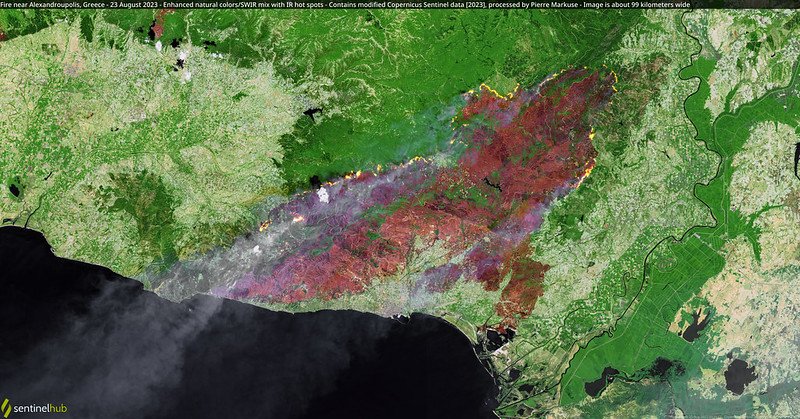
Images : Wildfires in Sakha Republic, Russia, August 13 2023; Wildfires in McDougall Creek, West Kelowna, British Columbia, Canada, August 20 2023; Wildfires near Athens, Greece, July 19 2023, enhanced natural colour/SWIR mix with IR overlay, all containing modified Copernicus Sentinel data and processed by Pierre Markuse.
Find out more about Robin’s work here.