An interview with post-doctoral Pyro-Ecophysilogist Dr. Raquel Partelli-Feltrin.
April 9th 2021. Melissa Sterry
A post-doctorate in the department of Botany at the University of British Columbia, Dr. Raquel Partelli-Feltrin researches how water-stressed trees respond to fire of varying intensities. Climate and fire regimes fast changing, Pyro-Ecophysilogy is central to understanding what that means for the future of forests. Here she shares her insights from the field…
MS: Describe your day-to-day research activities and aims.
RPF: My research is focused on the effects of fire on trees. More specifically, I am trying to understand the physiological responses of trees when they are exposed to different fire intensities. For example, how different fire intensities affect the photosynthesis process, and how such impacts could ultimately determine whether trees live or die in the aftermath of a fire. During my PhD program I had the opportunity to conduct some experimental work to better understand the effects of different fire intensities on tree saplings’ water transport and carbohydrates reserves. The findings from those studies were just the tip of the iceberg to start understanding how plants respond to fire. Today my research is still focused on how fire effects trees, but I am using fire behaviour linked with fire effects models and experimental work to better understand tree responses to fire.
MS: What are the most interesting insights that your research has so-far revealed about how wildland fires impact the tree species you study?
RPF: Some of the things we learned from these studies are: 1) trees under drought stress are more vulnerable to die even when they are exposed to low-intensity fires. For example, in one of my studies, I used small ponderosa pine saplings (Pinus ponderosa) and I drought stressed some of them, while keeping some well-watered, and then they were burned with different fire intensities. In this study, we found that all the saplings under drought stress died, while 70% of the well-watered plants survived when exposed to a low intensity fire. This suggested that plants under drought stress are more likely to die even if the fire does not burn very hot. 2) Trees that survive a fire can be more vulnerable to drought-induced mortality if a drought happens in the years immediately after the fire event. This has huge implications, considering the predictions of more severe and long periods of drought caused by climate change.
MS: How is research in tree physiology helping to illuminate the past, present, and possible future of forest fires in and beyond your study region?
RPF: Few studies related to tree physiology and fire were conducted in the past. Hence, there is a lot to be learned about fire effects on tree physiology. However, from the studies published, we know that trees, and consequently forests, are potentially more vulnerable to fire, and particularly when under drought stress. Coupling the results from these studies with climate change predictions (increase in drought and fire occurrence), it is likely that when fire happens in forests during a prolonged period of drought, regardless of whether the tree species are fire resistant or not, the probability that they will die is higher.
MS: Recent discoveries have illuminated trees, and in turn forests, to be many times more complex in their workings than previously recognised in non-indigenous cultures. Do you see these discoveries influencing how trees and forests are valued, and if so how?
RPF: I believe most people value forests based on the services that these ecosystems can provide for example, recreation, and goods such as timber, among other things. I think that all the research that shows the importance of forests in regulating the global climate, and their wider role in climate change, has also enabled many people to see the value of these ecosystems.
MS: Of the tree species you study, which do you think are the most remarkable and why?
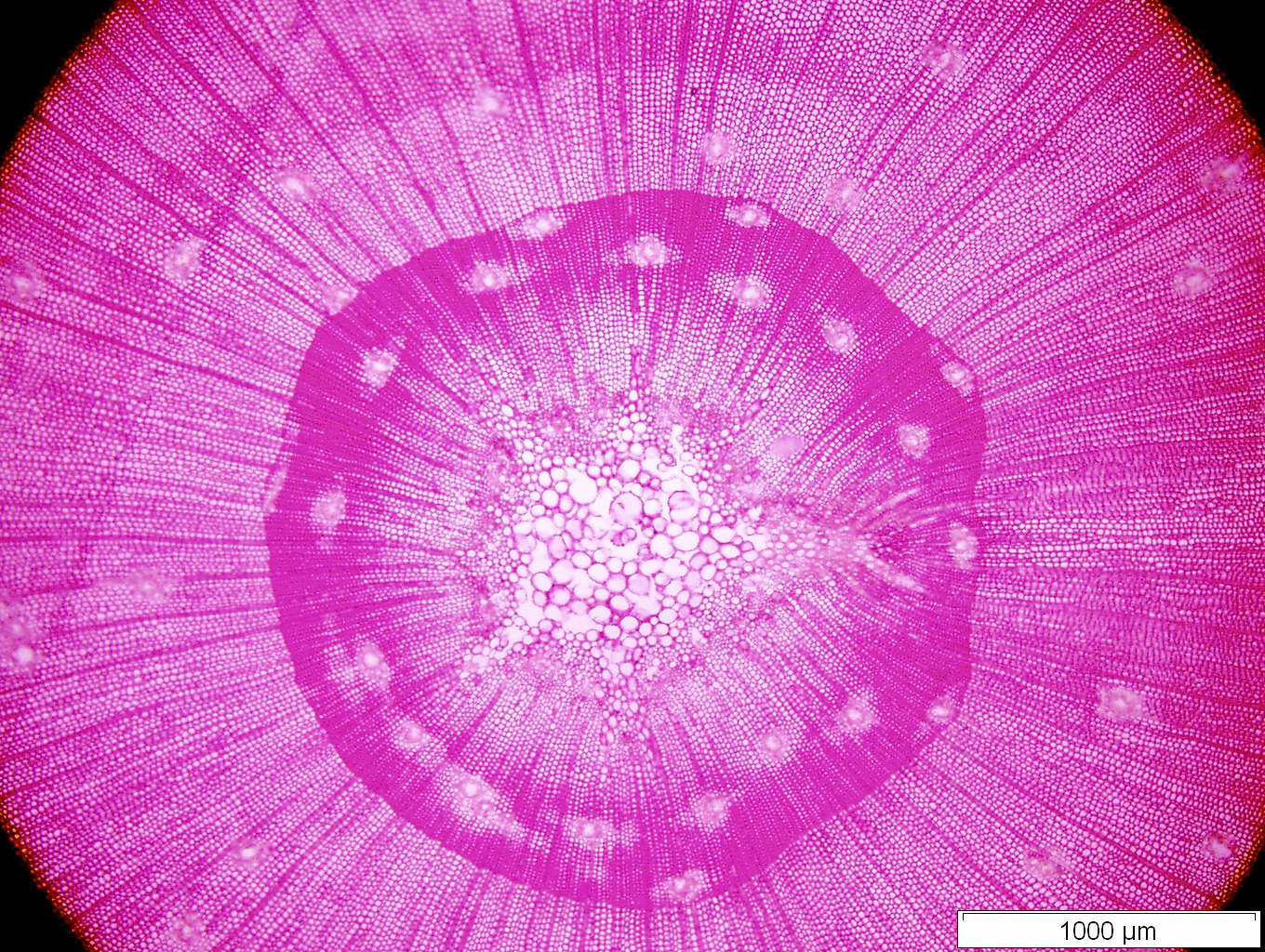
RPF: There is always something remarkable in every tree species that I study. But, particularly for me, the most remarkable are the anatomy of the water transport tissue formed in the vicinity of a fire scar in ponderosa pine (top image) and the beauty of the white pine (Pinus monticola) water transport tissue (middle image).
MS: If humanity could replicate one or more of the functional traits of these species, what do you think it should be and why?
RPF: I think photosynthesis would be the trait. Photosynthesis is the process by which plants produce their own food from CO2, water, and sunlight. Imagine if we, humans, could produce our own food using CO2, water, and sunlight. There wouldn’t be more than 820 million people hungry in the world, according an article published in the 2019 in the World Health Organization website.
MS: Have recent technological innovations [i.e. new imaging technologies] helped you in your research?
RPF: I haven’t used any new imaging technology in my research. But, there is no doubt that the new imaging technology, for instance high-resolution computer tomography (CT scan) that is already used in diagnosis of human health problems, can help to understand how plants work. There are a few studies where CT scan was used to assess plants’ water transport in vivo. Hopefully, these new technologies will become more affordable, thus more opportunities will emerge to use them to understand plants better.
MS: Do you anticipate advances in artificial intelligence and machine learning having applications in your future research activities, and if so, how?
RPF: Recently, I started learning about artificial intelligence application in biology studies. It has been used in ecology and environmental studies science and in a few studies related to plant physiology. I am very intrigued to learn more about AI. I believe the use of artificial neural network and fuzzy data could be very useful to model and predict the trees’ physiological processes to external stressor like fire, drought, and other natural disturbances.
MS: Images of the Amazon and Atlantic forests being slashed and burnt to make way for commercial activities have been prominent in the global press of late. What are some of the ways that citizens worldwide can help turn the tide on the destruction?
RPF: Unfortunately, the fire events that happened in 2019 in Amazon and Atlantic forest in Brazil are not uncommon. Not only that, but a significant part of the deforestation in these forests is related to pasture for cattle to sell as meat. Ermigassen et al [1] published a study in 2020 that showed that more than 40% of beef export is originated from cattle in the Amazon and Atlantic forests. So, I believe one way that every citizen can contribute to stopping the destruction of these and other forests is by making informed and responsible choices when buying meat and other products that are driving rampant deforestation.

MS: Thinking to they that, be they authors, colleagues, mentors, or other, have most influenced your research, who are they, and why?
RPF: The list would be long because I think all the people that I worked over these years had some influence in my research.
MS: The year is 2030. Systemic policy and wider failures have led to a worst-case fire in the landscape scenario. Describe what you see.
RPF: I expect to see more catastrophic fires burning in that scenario [ i.e. more intense and severe fires, where large areas of vegetation are completely consumed]. With that, we have the immediate and negative impacts for the ecosystems, as well as for humans. These extreme fires can cause high mortality of plants, which in turns affects the wildlife that depend on them for food, shelter, and reproduction. Because these fires typically remove all vegetation and make soils hydrophobic (water-repellent) regional water quality can be severely affected, as debris and sediment deposition transported post-fire by precipitation events, such as rainfall and snow melt, accumulates in rivers, lakes, and streams. In addition, the chances of landslides and floods in areas that have been devastated by wildfires is higher, and consequently these fires are a threat to any property and people that are located below these areas. Wildfires also adversely affect regional air quality, and in some instances, even that of areas located far from the burning area, because smoke can be carried for long distances. Also, these extreme fires are a threat to the lives and properties of people that live in communities located at the wildland-urban interface, where the probability of losses to such events is increasing.
MS: Vice versa. The year is 2030. Describe what you think to be the best-case fire in the landscape scenario.
RPF: Fires will always happen, so the best-case fire scenario would be the opposite of that which I describe above - it would be a fire that burns less intensely. Even though low-intensity fires are likely to kill some vegetation, they usually don’t consume it all, which decreases the risk of landslides and floods in and near burn areas in the aftermath of a fire. Air quality is also less affected by low-intensity fires than by catastrophic wildfires. Additionally, low-intensity fires can be controlled more easily, which decreases the risk of loss of life and homes at the wildland-urban interface.
References
[1] Ermgassen et al. 2020. The origin, supply chain, and deforestation risk of Brazil’s beef exports. PNAS, 117(50), 31770-31779.
Read more about Raquel’s research here.
Images: [Top] Fire-scarred plant tissue and [Middle] white pine (Pinus monticola) water transport tissue under microscope, and [Bottom] vivo pyro-ecophysiological experiment. All by Raquel Partelli-Feltrin.