An interview with artist Giacomo Costa
January 10th 2022. Melissa Sterry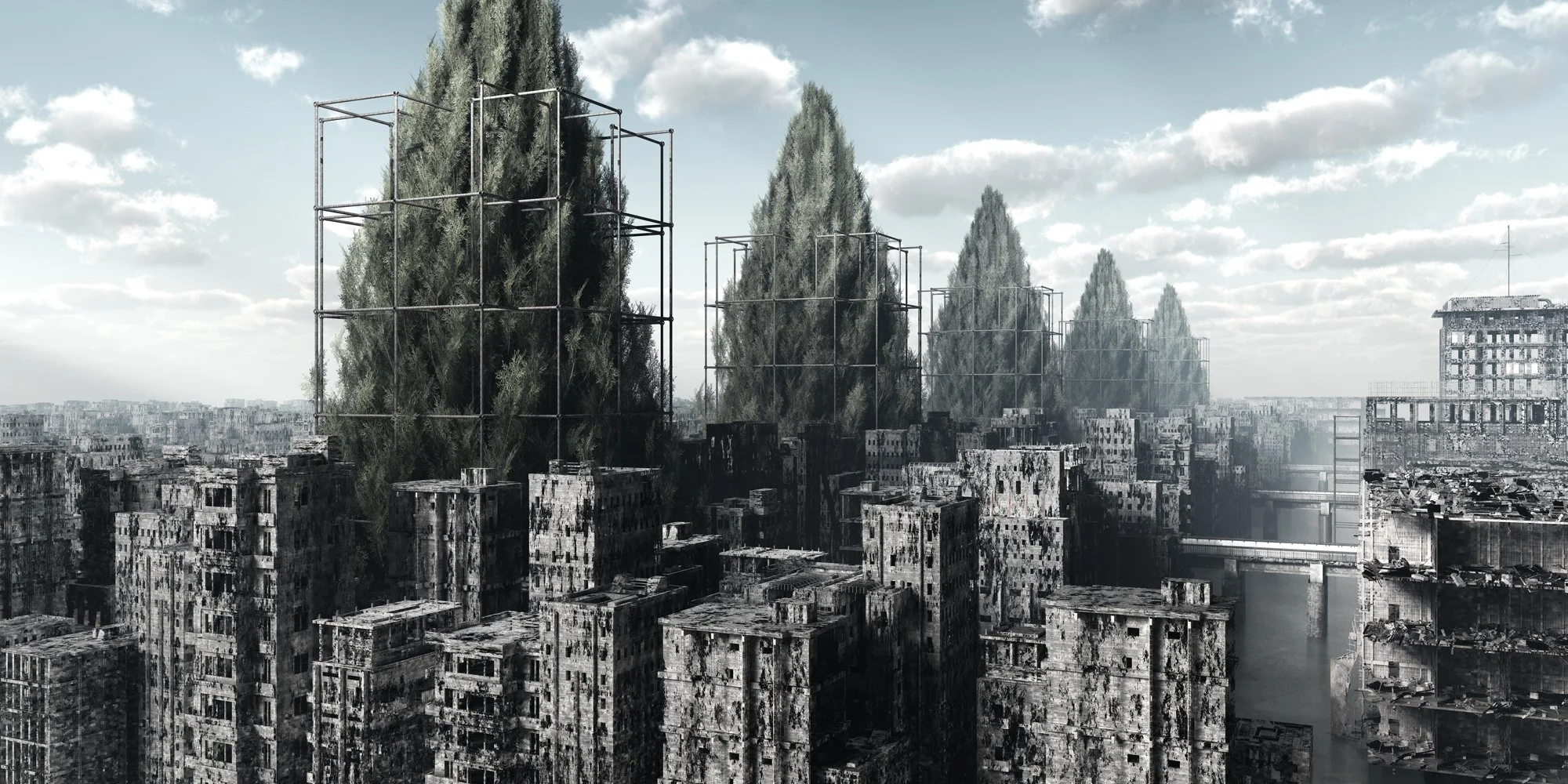
Having been exhibited at some of the world’s most prestigious events and venues, and featured in publications including a monograph by Damiani and Taschen’s Architecture Now! Giacomo Costa’s striking images invite us to contemplate our architectural and urban legacy. Visceral in its impact, yet intellectually provocative, his art speaks to spatial and time scales beyond the human, and to a deep disjunct in how our systems and those of the natural world work. Here Giacomo shares thoughts on the role of the arts in helping us to understand our place in this complex and ever-changing world…
MS: You live and work in one of the most architecturally sublime cities in the world, and a place where some of the greatest thinkers of the Global North created some of their most important works. How have the great Masters of Florence’s past inspired you and your work?
GC: I grew up in a very panoramic home with a view of the whole city and its best-known monuments, and so I pretty much live immersed in that atmosphere which has made Florence so famous as the centre of the Renaissance. This aesthetic did not directly inspire my work, but it is a part of my everyday life, and so it’s reflected in my images and my work.
MS: An artist of whom the works have been shown worldwide and in many prestigious international publications, your influence as an artist is as far-reaching as the relevance of the questions your works ask. How do you think working transborder – with people in places internationally – shapes your ideas about the world and the problems humanity now faces?
GC: The issues I address in my works apply to every place on the planet and to all the individuals who live on it, because sustainability, protection of the environment and reduction of the impact on our world of our way of living are issues no-one can escape or ignore. My reflection begins with observation of the world around me, and I see that the conclusions I have reached are ones that distant peoples and cultures share. And so I believe I can say that my artistic work and my considerations belong to a global movement that has taken form and grown in strength with the years. I first began creating my images in 1996, when environmental issues were not widely discussed, at least not in mainstream society. But things are changing quickly now, and our collective consciousness is growing. I believe the merit lies with everyone who focuses their attention and civic commitment on these issues.
MS: Your works often present scenes in which seemingly abandoned monumental architectures tower above landscapes from which they appear disconnected, and yet beholden to. Do you think of your work as a mirror of architectural and urban reality designed to make us question what architecture is and who it serves?
GC: You have pinpointed one of the key aspects of my work. I often use these oversized structures of uncertain origin, not necessarily built by human beings. These are metaphysical elements that may recall architectural structures or organic elements, almost like cells that have gone crazy, replicating with no apparent logic. They lead the viewer to doubt and ask questions, and they represent how human actions can be out of scale with the environment. This is a metaphorical representation of how the models of development in vogue at the present time are seriously compromising the balance of the planet.

MS: Architectural criticism has been largely conspicuous by its absence in much of the architectural and wider press. Then again, some of the ways in which current approaches to architectural and urban design fail are highly complex and sometimes difficult to convey within the limited word counts of newspaper and magazine articles. Art has always been a highly effective way of provoking reflection on how and why we, humanity, do the things that we do. Why do you think that is?
GC: As the cliché goes, "a picture is worth a thousand words". I believe the visual power of photography, its direct language, is the best instrument we have at this time in history for attracting attention to complex issues. We are living at a time when people have very low attention spans; the social media have accustomed us to conversations and reflections consisting of only a handful of words. This is why this saying is truer than ever, and why a powerful image can trigger a chain reaction in the way people imagine and perceive certain issues.
MS: One of the great concerns within the scientific and wider STEM community of the past several years has been the lag between the speed at which the climate is changing and the speed at which society is responding to that change. What role do you think art has to play in mobilising action on climate change and environmental issues more generally?
GC: My answer to this question is not very different from my answer to the previous question. We might say that architecture, and therefore our vision of the world in the near future, is of central importance in our reflection about climate change and how we ought to imagine the way we will live in the future. This is the key theme of the Architecture Exhibition at Biennale di Venezia that just closed, which perfectly demonstrated how closely connected these issues are, and how art can often be an essential tool for bonding together various aspects of reflection.
MS: One of your great skills as an artist is to present deeply dystopian urban scenes which, though entirely fabricated, nonetheless have a sense of gritty realism about them. Where do you think that sense of realism comes from?
GC: I started out as a photographer. My grandfather was a very experienced amateur photographer, practically a pioneer; he made his own cameras, experimented and invented things. I grew up watching him work in the darkroom. I was incredibly fascinated by the magic of the image appearing on a blank piece of photographic paper. Photography is still my starting point today. We all believe that a photograph represents the truth, even though we know perfectly well how easily it can be manipulated. When I create an entirely artificial image, I always set myself the goal of making it look like a "possible" photograph, because only in this way can I create that magic in the viewer, that instant in which you’re not sure whether what you are looking at exists in reality or not. And, in fact, I teach photography at the fine arts school, because this is the idiom I know best, the foundation of all my artistic work.

MS: Another consistent theme in your work is the natural elements – fire, water, air, earth, ether - and more particularly, the relationship between those elements and the architectures and urbanscapes your works depict. Thinking of the events taking place off-canvas, of how climate change is impacting upon cities and societies at large, how would you like to see architecture and urban design change to help tackle the great environmental and social challenges of our time?
GC: I am not an architect, and I have no specific training that allows me to venture into real hypotheses. I’m inspired by the idea that buildings are not just elements grafted onto the land but a part of it, that they should be like natural parts of the landscape. Before beginning to work in art, I was a mountain-climber for many years, and it was in the mountains that I first began to reflect on our relationship with our environment. Living surrounded by nature, sleeping on the side of a mountain, in a shelter or a tent on the ice, are experiences I have kept within me, experiences that reveal to me how human beings and nature are a single whole, at times harmonious and at times dissonant. I believe architecture needs to harmonise all the elements of our lives and our way of living.
MS: Thinking of your peer group, and of others whose work explores issues at the interface of human and non-human society, which artists do you think are creating some of the most interesting and compelling work?
GC: There are many artists I find interesting and compelling. At this time I am very much attracted to the work of Stefano Mancuso, whose scientific studies of the plant world, neurobiology and plant intelligence have a lot to do with my work. He had a big installation at the architecture Biennale, and it is not chance that it was right across from my photographs. I’m also very fond of Olivo Barbieri’s work and his truly original way of representing the city. He is one of the great fathers of Italian photography, which is, as I have said, an important reference for me.
MS: As someone whose work often explores dystopian alternative presents and possible futures, describe your worst fears for the coming decade and beyond.
GC: I am very worried about the fact that the people running the world do not recognise the gravity of the present time, and lack the will and the courage to start seriously rethinking the way our society ought to be organised in order to address the issues we’ve been talking about.
Images : Giacomo Costa.
Find out more about Giacomo’s work here.