
Design for Living with Wildfire
Positing the potential for developing architectural, urban and peri-urban resilience to wildfires through the creation of adaptive material and information systems that mimic the biochemistries, behaviours, structures, and relationships of plant and animal species that have evolved to live with fire, and the ecosystems they form.
Panarchistic Architecture emerged from a groundbreaking transdisciplinary research programme that examined the intricate interactions between abiotic (non-living), biotic (living), and anthropogenic (human) systems over deep time and space. It’s an unprecedented nature-inspired approach that offers a critical, yet innovative perspective on the highly complex challenge of design for coexisting with wildfires.
Rooted in advanced research from multiple fields, Panarchistic Architecture synthesises data spanning diverse forms, disciplines, epochs, and global research communities. The works presented here document the theoretical evolution of original architectural, urban, and landscape material and information systems that are specifically designed to align with the fire regimes of their environments. These systems collectively represent a revolutionary new paradigm in architectural, urban, and peri-urban resilience, which is capable of persisting in the presence of wildfires of varying intensities, behaviours, and severities: the seminal bio-inspired design approach to problem of living with wildfire.
The underlying logic of these mimetic systems is thoroughly examined in an extensive PhD thesis, which published in 2018 by design scientist and systems theorist Melissa Sterry, integrates insights from over 1,500 research papers, surveys, books, and other published materials, and draws on interviews and discussions with foremost experts across a range of fields, including fire science, information technology, biotechnology, materials science, engineering, design, urban planning, policymaking, social and natural history, and more.
The term ‘Panarchic Codex®’ originally referred to speculative building codes that were designed to illustrate how the Panarchistic Architectural paradigm could be implemented in both policy and practice, and that also serve as tools to educate and inspire designers, architects, planners, and policymakers in workshops and other active learning environments. Following the publication of these codes and the associated thesis, its use was extended to cover related research, development, and publishing efforts, some of which are available on this site. Over time, additional resources will be added, including currently embargoed works as well as new content such as essays, ebooks, talks, interviews, and fireside chats.
In the interim between the publication of Panarchistic Architecture and the present, Dr. Sterry has continued with her research into how pyrophytes (plants that have evolved to live with wildfire) can inform, inspire, and enable design for buildings and other built infrastructure in the fire-prone regions of the world. She has completed further field studies both in and beyond California; more interviews with foremost experts working at the edge of multiple fields of science, technology, engineering, design, planning, and policy; advanced research and development of several seminal architectural and urban resilience design concepts that integrate the biochemistries, behaviours, structures, and relationships of pyrophytes in a way that’s synchronised with local fire regimes; built a global research and collaboration community; and delivered ongoing insights on her design for wildfire research, its applications, and possible impacts in a series of keynotes delivered at leading international design, architecture, and planning conferences, as well as in interviews, articles, and chapters for academic, trade, and consumer press and media worldwide.
Wildfire being a phenomena that’s intimately bound with other natural hazards including flooding, debris falls, and disease, from the outset the Panarchistic Architecture paradigm was conceived as a systems-led approach that not merely examined risks during and immediately after fires, but over years, decades, and centuries, while also accommodating of the fact that the impacts of wildfire are not merely localised, but as explained in the thesis, extend to the planetary scale. Recent field studies and advances in Earth Systems science have led Dr. Sterry to further develop an ‘ecosystem of architectures’. Presenting not one, but several nature-inspired approaches to coexisting with natural hazards, this system of design includes both Pyrophytic Architecture™ and Xerophytic Architecture™, the former named after pyrophytes and the latter xerophytes, which are plant species that have evolved to live in desert conditions.
Those interested to learn more will find an array of open access learning materials on this site, of which some are authored with field experts in mind, whereas others are designed to be accessible to those without pre-existing knowledge of fire ecology and related sciences. Yet more information can be found at embedded links and through Panarchic Codex®’s social media accounts, including links to recordings of talks, podcasts, and more.

Panarchistic Architecture
a brief synopsis
By advancing biomimicry from the level of individual species to entire systems [ecomimicry], Panarchistic Architecture rejects generic notions of Nature and instead rigorously examines the interactions between living and non-living processes from the molecular to the landscape and planetary scale, across both human and geological timescales. The paradigm introduces several original theoretical and technical concepts in architecture and urban planning, exploring their potential applications
and implications both within and beyond the wildland-urban-interface. Also drawing on insights from indigenous and ancient fire cultures that are native to Northern America, among other continents, Panarchistic Architecture proposes that reconciling human and non-human systems in fire-prone wildland-urban areas is not only possible, but also holds significant ecological, social, and technological potential, warranting further research in the years and decades to come.

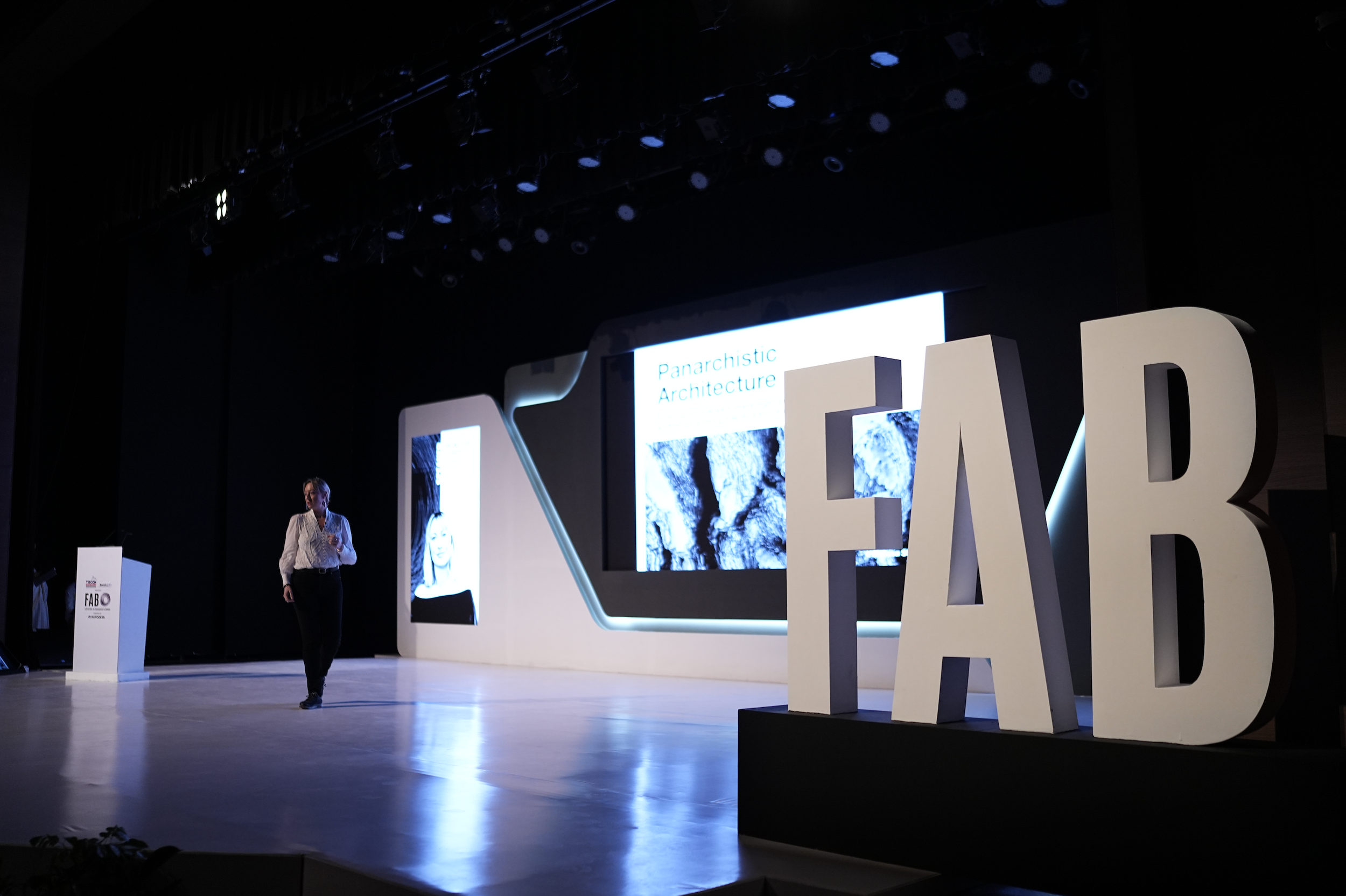
Images: [Top/Bottom] Retardant BIObark™, Melissa Sterry ©; [Middle] Dr. Sterry’s Panarchistic Architecture presentation at FAB conclave, Mumbai 2024